

Dating someone with an avoidant attachment style can feel like an unpredictable dance. One day, you share a moment of genuine closeness and emotional warmth; the next, you are met with sudden withdrawal, unanswered messages, or a cool distance that leaves you wondering what went wrong.
When closeness is followed by distance, vulnerability by withdrawal, or connection by silence, it is completely natural to question where you stand. You might spend hours dissecting recent conversations, wondering if you asked for too much, moved too quickly, or said the wrong thing.
Understanding attachment dynamics allows us to view these patterns through a psychological lens rather than taking them personally. Recognizing someone’s attachment style does not mean abandoning your own emotional needs to accommodate theirs. Healthy love requires far more than intense feelings, it requires emotional availability, consistency, open communication, and a shared willingness to stay present even when intimacy feels uncomfortable.
What Is Avoidant Attachment? The Psychology Behind the Withdrawal
To navigate this dynamic without losing your own balance, it helps to understand how avoidant attachment develops and manifests in adult romantic relationships.
Rooted in Bowlby’s Attachment Theory, attachment styles represent cognitive frameworks and behavioral strategies formed early in life to cope with caregiving environments. Individuals who develop a dismissive-avoidant attachment style often grew up in environments where their emotional expressions were rejected, dismissed, or met with overwhelming expectations of self-reliance.
As an adaptive mechanism, the brain learns that relying on others is unsafe or unreliable. In adulthood, this defense mechanism persists as hyper-independence and emotional suppression.
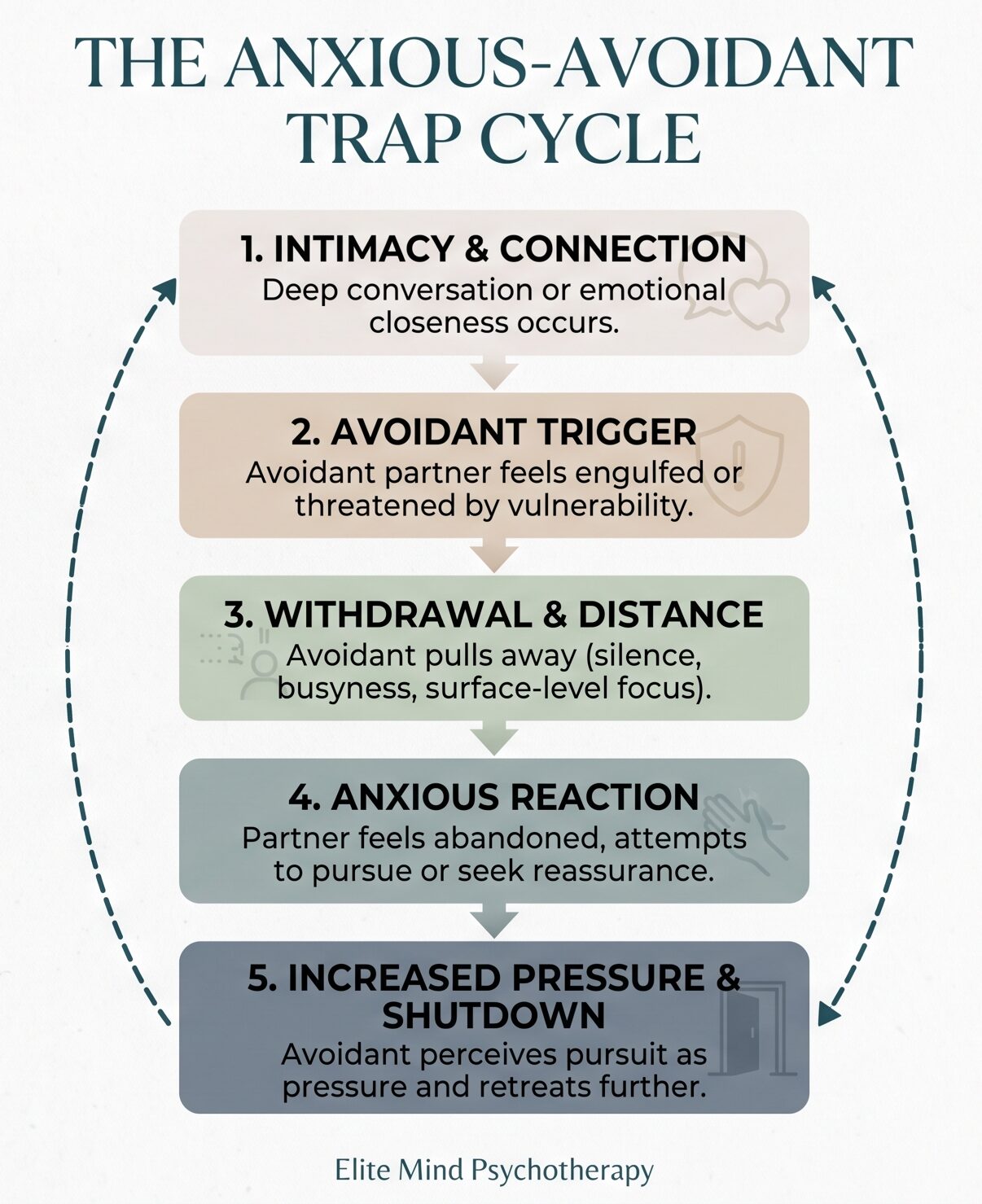
When closeness deepens, an avoidant partner’s nervous system registers that vulnerability as a threat to autonomy. The pull-away response is rarely a calculated punishment; it is an automatic protective reflex designed to regulate overwhelming internal anxiety.
Relationships as Mirrors: What Your Triggers Reveal
Relationships operate as mirrors. They reflect our early childhood wounds, our underlying relationship patterns, our deepest fears, and the unhealed parts of ourselves asking for attention and integration.
When dating an avoidant partner, their withdrawal often acts as an amplifier for our own internal insecurities. If you hold an anxious attachment style or a core fear of abandonment, an avoidant partner’s distance will trigger an intense physiological threat response.
Distinguishing Attachment Reactions
Understanding how different attachment dynamics interact helps clarify whether an argument stems from individual triggers or fundamental relationship incompatibility.
| Emotional Dimension | Anxious Attachment Dynamic | Avoidant Attachment Dynamic | Secure & Healthy Dynamic |
| Core Primary Fear | Abandonment, rejection, being uncared for or replaced. | Engulfment, loss of autonomy, being controlled or judged. | Loss of authentic connection while maintaining self-identity. |
| Response to Conflict | Pursuing, hyper-activating strategies, seeking immediate reassurance. | Deactivating strategies, stonewalling, seeking immediate physical or emotional space. | Direct communication, emotional regulation, collaborative problem-solving. |
| Internal Narrative | “I am only safe if I can keep them close and fix this right now.” | “I am only safe if I rely strictly on myself and pull back.” | “We can navigate difficult emotions together while maintaining boundaries.” |
| Growth Opportunity | Learning self-soothing, honoring personal boundaries, and tolerating temporary space. | Learning to tolerate emotional intimacy, communicate needs, and stay present during discomfort. | Maintaining consistency, practicing empathy, and honoring mutual needs. |
What triggers us most in another person is often an invitation to look deeper within. Asking yourself “Why does their distance feel so unbearable right now?” or “Am I abandoning my own boundaries to keep this person comfortable?” allows you to shift from passive reactivity to conscious self-awareness.
Rejection vs. Self-Worth: Deconstructing the Pain of Unchosen Love
Few experience types sting as deeply as emotional rejection from a partner or dating prospect. When someone pulls away or chooses not to commit, it is easy to internalize that choice as a verdict on your inherent value.
Rejection can hurt, but it does not get to define you.
Psychological research on rejection sensitivity demonstrates that social rejection activates the same neural pathways as physical pain, specifically the anterior cingulate cortex. Your brain registers relational distance as genuine distress.
Someone choosing not to choose you does not determine your worth, your beauty, or what you deserve in a partnership. It simply indicates a mismatch in emotional availability, capacity, or timing.
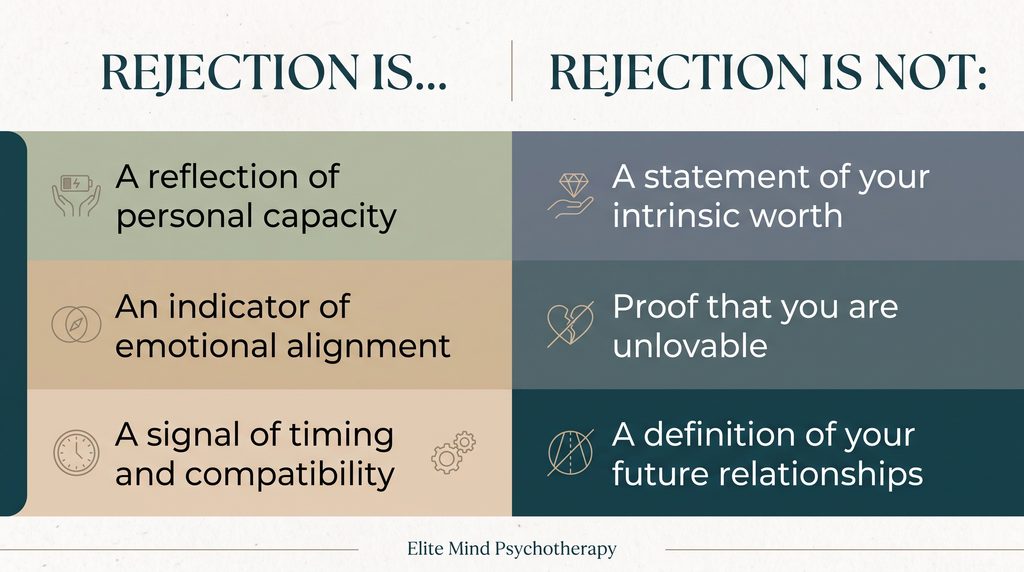
Rejection is an experience you pass through, not an identity you become. When you separate your self-worth from another person’s capacity to love you, emotional distance ceases to feel like a personal failure.
Compassion Without Self-Sacrifice: Setting Healthy Boundaries
It is entirely possible to hold deep empathy for someone’s past trauma and attachment wounds without making yourself responsible for healing them.
You cannot heal an avoidant partner by shrinking your needs, suppressing your voice, or accepting breadcrumbs of affection. True compassion respects both their journey and your own emotional well-being.
- Define Your Non-Negotiables (Identify where empathy ends and self-neglect begins): Write down your core emotional needs in a partnership (e.g., consistent communication, mutual respect, shared future goals). Acknowledge that desiring these is healthy and non-negotiable.
- Communicate Directly via ‘I’ Statements (Express feelings clearly without accusations or demands): Frame your requests around your own experience rather than criticizing their attachment style. For example: “I feel disconnected when we go several days without talking, and I need consistent check-ins to feel secure in our relationship.”
- Evaluate Response & Willingness to Grow (Observe action over verbal promises): Observe how your partner responds to your boundary. A partner willing to build a healthy relationship, even with an avoidant attachment style, will acknowledge your needs and work incrementally toward emotional presence.
- Enforce Boundaries with Self-Respect (Protect your emotional integrity if patterns remain static): If your partner repeatedly dismisses your boundaries, shuts down communication, or demands complete emotional absence, recognize that staying requires abandoning yourself. Choosing to step away is an act of self-preservation, not failure.
Professional Support at Elite Mind Psychotherapy
Navigating complex attachment patterns, healing from romantic rejection, and breaking repetitive relationship cycles requires dedicated space, objective guidance, and clinical expertise.
Located in Burlington, Ontario, Elite Mind Psychotherapy offers compassionate, evidence-based psychotherapy for individuals and couples seeking healthier dynamics, emotional resilience, and personal growth.
Led by Roneldi Feaver, MA, BSc Hon., RP, a Registered Psychotherapist in Ontario, Elite Mind Psychotherapy provides individualized care grounded in modalities such as Dialectical Behaviour Therapy (DBT), couples therapy, and stress management.
Practice Information & Contact Details
- Therapist: Roneldi Feaver, MA, BSc Hon., RP (Registration #: 008085)
- Practice: Elite Mind Psychotherapy
- Location: 895 Maple Avenue, Burlington, ON, L7S 2H7
- Phone: 905-301-4281
- Email: roneldif@gmail.com
- Service Formats: In-Person Sessions in Burlington, ON & Secure Online Therapy Across Ontario
- Core Specialties: Individual Psychotherapy, Couples Counselling, Attachment & Relationship Patterns, Burnout & Stress Management, Dialectical Behaviour Therapy (DBT), and Therapy for First Responders
- Hours: Monday – Friday: 9:00 AM – 7:30 PM
If attachment uncertainty or rejection has begun shaping how you view yourself, you do not have to navigate it alone. Visit Elite Mind Psychotherapy to schedule an initial consultation and take the first step toward reclaiming your peace, boundaries, and emotional self-worth.