

How many times have you broken your own heart just to avoid disappointing someone else?
Every time you silence your needs, dismiss your internal feelings, or abandon your personal boundaries to keep someone close, you risk losing connection with yourself. Love and connection should never require you to disappear.
In clinical practice, this pattern is known as emotional self-abandonment. It occurs when you repeatedly suppress your own authentic thoughts, emotional signals, and physical limits to appease others, avoid conflict, or secure connection. While it often feels like kindness or empathy in the moment, self-abandonment is actually an anxiety-driven coping mechanism that undermines self-worth and leads directly to emotional exhaustion.
Healing begins when you realize that choosing yourself is not selfish. It is necessary.
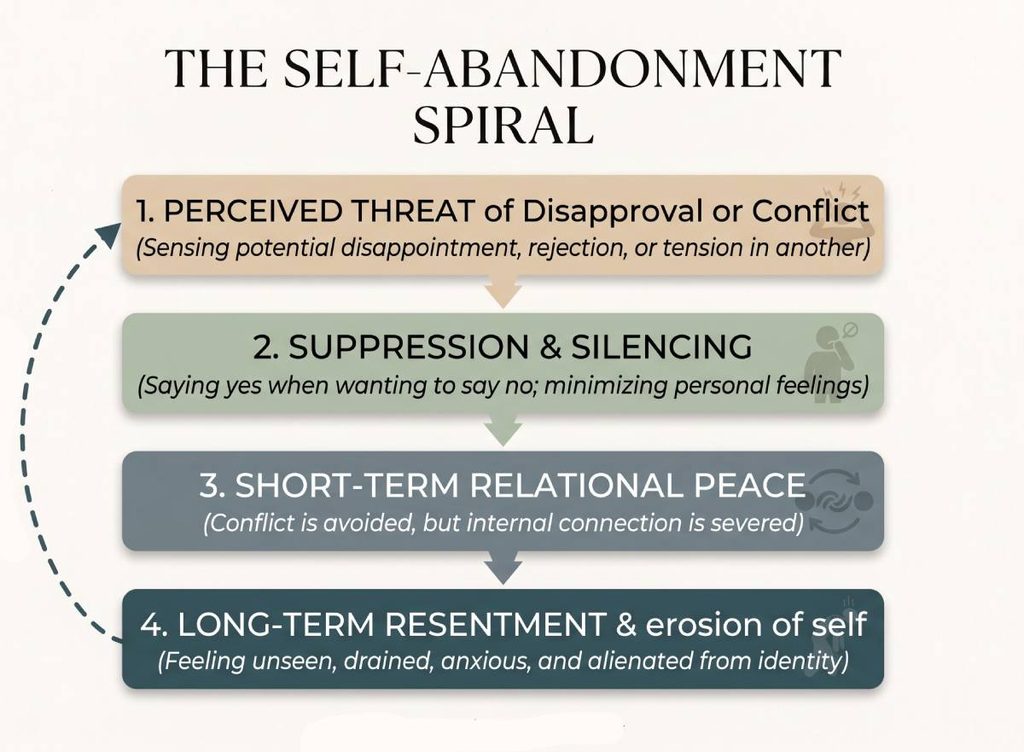
5 Signs You Are Emotionally Abandoning Yourself
Self-abandonment can be subtle. Because society often praises self-sacrificing behavior, it is easy to mistake self-neglect for maturity or selflessness. Recognizing the signs is the first step toward reclaiming your agency.
1. You Say Yes When You Really Want to Say No
Agreeing to requests, social engagements, or additional workload when your energy is depleted is a primary indicator of self-abandonment. When “yes” comes from a fear of rejection rather than genuine willingness, it compromises your integrity.
2. You Minimize Your Feelings to Avoid Conflict
Telling yourself that “it isn’t a big deal,” “I am just being too sensitive,” or “I shouldn’t feel this way” when someone hurts or boundary-crosses you is a form of internal gaslighting. Minimizing your emotional signals teaches your nervous system that your internal reality does not matter.
3. You Prioritize Being Liked Over Being Authentic
When your choices are consistently governed by what will make others approve of you rather than what aligns with your core values, you trade authenticity for attachment. Over time, this creates a profound sense of emptiness because the person being liked is a curated mask, not your authentic self.
4. You Tolerate Behavior That Repeatedly Hurts You
Remaining in dynamics where disrespect, emotional distance, or boundary violations are routine requires you to mute your self-protective instincts. You rationalize mistreatment to keep the dynamic intact, choosing relational comfort over personal safety.
5. You Feel Guilty When You Put Yourself First
If taking rest, expressing a boundary, or prioritizing your health triggers an immediate wave of shame or guilt, your self-worth has become dependent on external approval. You have been conditioned to view self-care as an act of betrayal against others.
The Psychological Roots: Why We Learn to Disappear
Self-abandonment rarely develops in a vacuum. In psychological framework, it is frequently a learned survival response originating from early developmental or relational experiences.
| Relational Dimension | Self-Abandonment | Self-Alignment |
| Core Motivation | Fear of rejection and conflict avoidance | Internal integrity, authenticity, and self-worth |
| Boundary Style | Porous, non-existent, or easily compromised | Clear, firm, grounded, and compassionate |
| Conflict Response | Self-silencing, compliance, and over-adaptation | Direct, honest, and respectful dialogue |
| Relational Impact | Chronic resentment, codependency, and fatigue | Authentic mutual respect and secure connection |
| Emotional State | Low-grade anxiety, guilt, and emotional exhaustion | Internal stability, self-trust, and confidence |
Attachment Security and Fawning Responses
When children grow up in environments where emotional expression was met with rejection, anger, criticism, or withdrawal, they quickly adapt. According to attachment theory, a child will always prioritize proximity to caregivers over authentic self-expression.
This adaptation often manifests as the fawn response (one of the classic trauma responses alongside fight, flight, and freeze). Fawning is the habit of pleasing, appeasing, and neutralizing threats by anticipating the needs of others. In adulthood, this strategy persists: you automatically abandon your needs because your nervous system still equates external conflict with abandonment or danger.
The Illusion of Safety in People-Pleasing
People-pleasing offers a temporary illusion of control. If you can keep everyone around you happy, calm, and satisfied, you feel safe. However, this safety comes at a devastating price. By spending all your energy regulating the emotions of others, you forfeit the ability to regulate and honor yourself.
How to Stop Emotionally Abandoning Yourself
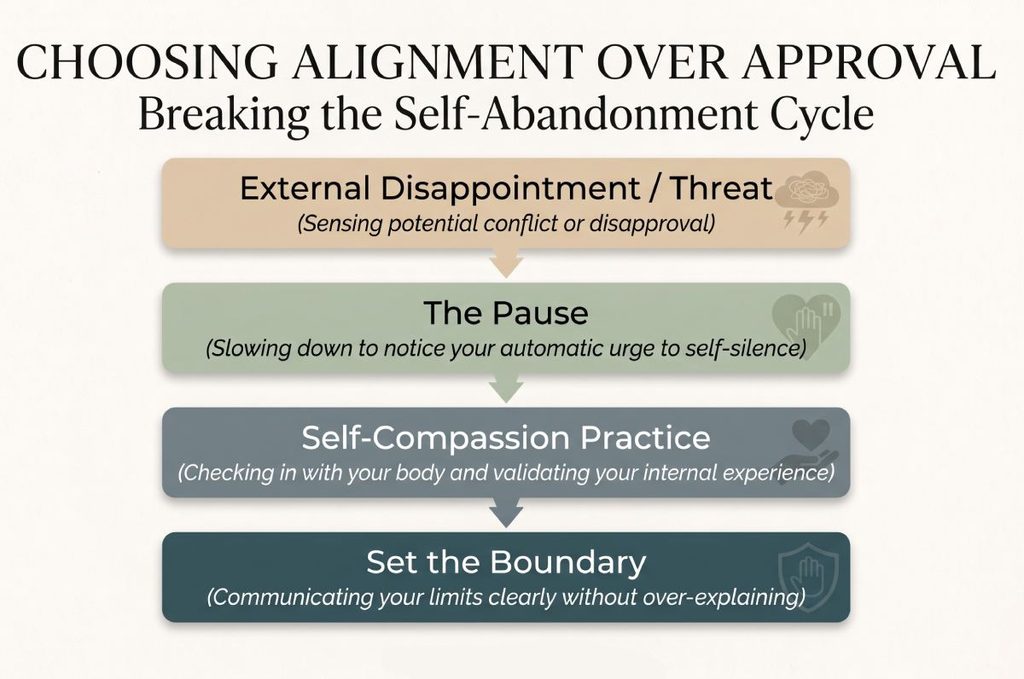
Unlearning self-abandonment is an active practice of rebuilding self-trust. It requires shifting from external validation to internal alignment.
1. Get Clear on Your Needs
You cannot honor needs that you do not acknowledge. Begin by checking in with yourself throughout the day. Ask simple, direct questions: “What am I feeling right now? What do I need at this moment? What is my body telling me?” Remind yourself that your feelings and needs are inherently valid.
2. Set and Hold Boundaries Without Guilt
Boundaries are not walls to push people away; they are clear guidelines that teach others how to hold space for you safely. Start small. Practice setting clear limits around your time, energy, and capacity. Remember that guilt is simply a sign that you are breaking an old habit of self-neglect, not proof that you are doing something wrong.
3. Use Your Voice
Expressing your feelings honestly and directly feels uncomfortable when you are accustomed to self-silencing. Practice speaking your truth in low-stakes situations before navigating high-stakes conversations. Clear, direct communication removes ambiguity and allows others the opportunity to meet you authentically.
4. Choose Alignment Over Approval
Shift your primary question from “Will they like me if I do this?” to “Is this decision in alignment with my values and well-being?” Making choices that feel right for you, even when they cause temporary disappointment to others, is fundamental to building self-efficacy and self-worth.
5. Practice Self-Compassion
Be as understanding, kind, and supportive with yourself as you are with the people in your life. When you catch yourself slipping into old people-pleasing patterns, refrain from harsh self-criticism. Recognize the pattern with curiosity, extend self-compassion, and re-anchor in your boundaries.
Reclaiming Your Authentic Self Through Individual Therapy
Breaking free from deep-seated patterns of self-abandonment, boundary impairment, and people-pleasing requires a safe, structured environment. Trying to change years of nervous system conditioning on your own can feel overwhelming, especially when loved ones are used to your compliance.
At Elite Mind Psychotherapy in Burlington, Ontario, Registered Psychotherapist Roneldi Feaver (MA, BSc Hon., RP) works closely with clients through dedicated Individual Therapy. Therapy offers a supportive space to explore the root causes of self-silencing, untangle complex relational patterns, and develop practical tools for emotional regulation and self-advocacy.
Through evidence-based approaches, including Dialectical Behaviour Therapy (DBT) and Burnout & Stress Management, individual counselling helps you:
- Identify and dismantle long-standing fawn responses and people-pleasing behaviors.
- Reconnect with your bodily intuition, emotional needs, and personal values.
- Learn to set, communicate, and hold healthy interpersonal boundaries without overwhelming guilt.
- Build genuine self-worth that is grounded internally rather than tied to external performance or approval.
- Transition from surviving relational dynamics to thriving in authentic, balanced partnerships.
You can be a caring, loving, and empathetic person while still choosing yourself. Learning to stand firmly in your worth does not diminish your capacity to love others; it ensures that the love you offer is authentic rather than born of sacrifice.
Practice Information & Contact Details
- Therapist: Roneldi Feaver, MA, BSc Hon., RP (CRPO Registration #: 008085)
- Clinic: Elite Mind Psychotherapy
- Address: 895 Maple Avenue, Burlington, ON, L7S 2H7
- Phone: 905-301-4281
- Email: roneldif@gmail.com
- Care Format: In-person sessions in Burlington & secure online therapy across Ontario
- Hours: Monday – Friday, 9:00 AM – 7:30 PM
If you are ready to stop breaking your own heart to keep others happy, take the first step today. Visit the Elite Mind Psychotherapy website or reach out directly to schedule an initial consultation for Individual Therapy. Reclaim your voice, honor your needs, and rebuild a relationship with yourself rooted in security and self-respect.